
From a small stall to a successful brand
Meena, a young MBA graduate in Chidambaram, grows her family's millet breakfast stall. You are her marketing advisory team. Twenty-four episodes, four parts, twelve hours — one decision at a time.
Facilitator: Prof. (Dr.) A. Selvarasu · Illustrative teaching case — characters and figures are fictional.
Sign in to take the six-question quiz for each part and earn completion certificates.
Sign in for quizzes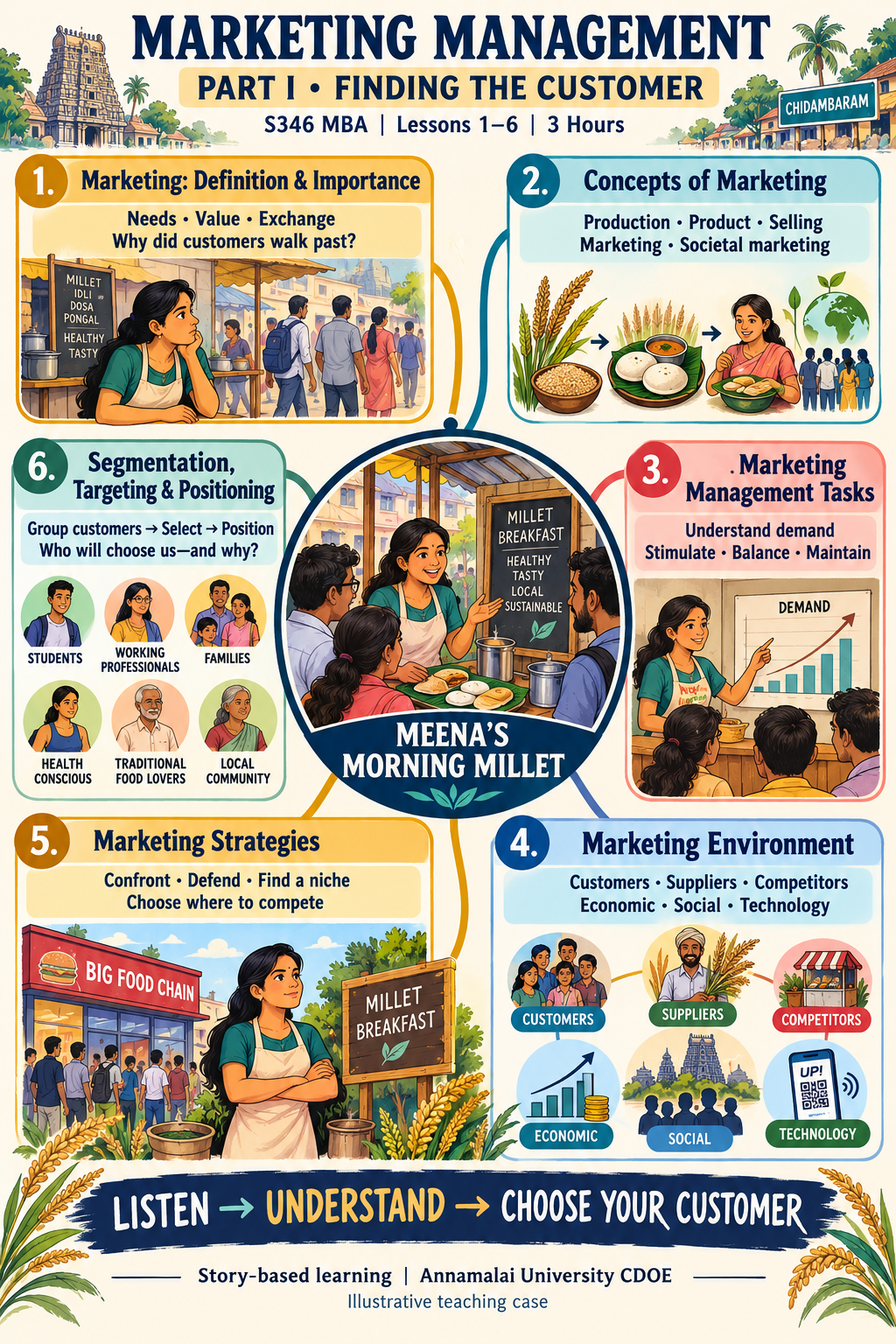
S346 MBA · Lessons 1–6 · 3 hours
Part I — Finding the Customer
Listen → Understand → Choose your customer
Participant handout (PDF)Quick flash
- Start every answer with the customer need, not the product.
- Name the demand condition before choosing a marketing task.
- Use “For [target], our [offering] provides [benefit] because [support]”.
- Run the 180-minute route: six 25-minute lessons, a break and a team pitch.
- Use the five-orientation debate in Lesson 2 to energise the room.
- Close with the one-page customer and strategy brief as an exit ticket.
- Use the change → implication → response log for client environment scans.
- Test niche fit: where do the client's capabilities matter most?
- Insist on a measurable objective before endorsing any strategy.
Fifty millet breakfast packs remained unsold at eight o'clock. Kavya, a student, needed breakfast but had only five minutes, feared a leaking container and could not see the price.
Meena: “She needs breakfast that fits her journey, time, and budget.”
Concepts: Marketing starts with needs and builds an offering that creates value and supports exchange. Place, time and possession utility. Selling is only one activity.
Team activity (10 min): Complete: Our customer is not simply buying ___. The customer is trying to achieve ___. Suggest one change to the stall.
Remember: Marketing connects the offering to the customer's life.
Raman wanted bigger production, the cook a perfect recipe, Arjun bigger discounts. Meena interviewed students, commuters and families — and noticed discarded packaging outside.
Meena: “Only if the offer already addresses a need worth paying for.”
Concepts: Production, product, selling, marketing and societal marketing orientations — each with a different starting point.
Team activity (10 min): Five groups, one orientation each: a one-minute recommendation to Raman. Retain one useful idea from each.
Remember: Customer understanding gives direction to business effort.
Some disliked millet, some never considered it, office workers wanted something new. Weekdays busy, Sundays quiet, festival orders beyond capacity.
Meena: “Before choosing an action, name the demand problem.”
Concepts: Negative → conversional; no → stimulatory; latent → developmental; declining → remarketing; irregular → synchromarketing; full → maintenance; excessive → demarketing; unwholesome → countermarketing.
Team activity (10 min): Choose one demand condition: describe the evidence, select the task and recommend one action.
Remember: Manage the level, timing, and nature of demand.
Ingredient prices rose, a cafe began delivery, rain cut footfall and an office changed reporting time. The recipe had not changed — the conditions had.
Meena: “Our customers and operating conditions did.”
Concepts: Immediate environment: customers, suppliers, competitors, intermediaries. Wider: economic, social, cultural, technological, political, ecological.
Team activity (10 min): For four headlines (packaging costs, mobile ordering, earlier office hours, rain) write: change, implication, response.
Remember: Observe the environment and adapt with purpose.
A large restaurant opened with low-priced combos. Arjun proposed a price war. Meena found commuters needing dependable collection before 8:30 a.m.
Meena: “We must choose where our capabilities matter most.”
Concepts: Confrontation, defensive, niche, demarketing and remarketing strategies — linking opportunity, objectives, resources and competitive choices.
Team activity (10 min): We recommend ___ because customers need ___ and we can reliably provide ___. Add a measurable target such as 30 repeat weekday customers in a month.
Remember: Strategy is a supported choice about where and how to compete.
Raman suggested “Breakfast for Everyone”. Meena compared students, families, commuters and institutions, chose commuters, and promised familiar breakfast ready before work.
Meena: “We can welcome buyers while focusing our resources on a clear target.”
Concepts: Segment meaningfully, evaluate and select, then position a distinctive value proposition. Geographic, demographic, psychographic, behavioural and industrial bases.
Team activity (10 min): Create three segments, choose one with reasons, write a positioning statement and name the operational promise behind it.
Remember: Select a customer and make a credible promise.